
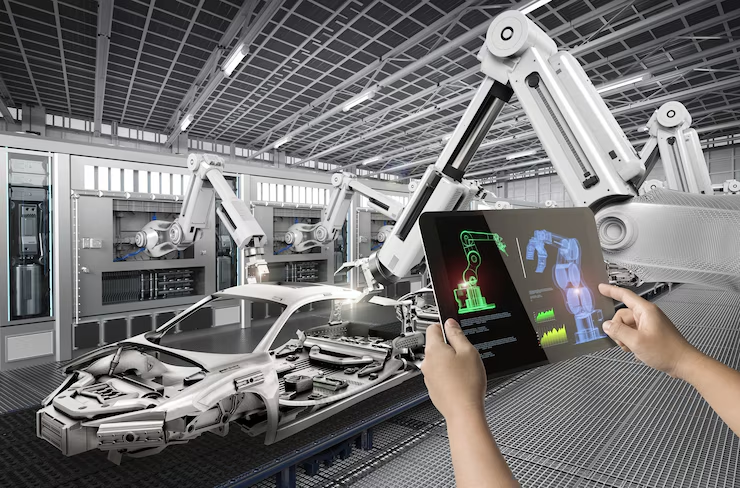

In the automotive manufacturing industry, precision and efficiency are paramount, especially when it comes to managing small components like connectors. Traditional counting methods, such as manual tallying or weight-based estimation, often fall short in accuracy and reliability. To address these challenges, manufacturers are increasingly turning to advanced technologies like Automated Optical Inspection (AOI) systems and machine vision systems to automate the counting process of automobile parts.
Limitations of Traditional Counting Methods
Traditional methods for automobile parts counting present several challenges:
- Manual Counting: This approach is labor-intensive, time-consuming, and prone to human error, especially when dealing with large quantities or intricate parts.
- Weight-Based Estimation: Assuming uniform weight for all parts can lead to inaccuracies due to variations in individual part weights, packaging materials, or contaminants.
These limitations can result in inventory discrepancies, shipping errors, and increased operational costs.
Implementing Machine Vision Systems for Parts Counting
Integrating a machine vision system into the production line involves several key components:
- High-Resolution Imaging: Cameras are strategically positioned to capture detailed images or videos of parts as they move along the conveyor belt.
- Advanced Image Processing: The system utilizes sophisticated algorithms to detect, identify, and count individual parts in real-time, accommodating various sizes, shapes, and orientations.
- Automated Conveyor Control: The system can be programmed to stop the conveyor once a predetermined count is reached, facilitating efficient packaging and inventory management.
Advantages of AOI and Machine Vision Systems
Adopting AOI and machine vision systems for automobile parts counting offers numerous benefits:
- Enhanced Accuracy: Automated systems significantly reduce human error, ensuring precise counts and minimizing discrepancies.
- Increased Efficiency: Real-time counting accelerates the production process, reducing bottlenecks and improving throughput.
- Cost Savings: Accurate counting minimizes overages and shortages, leading to better inventory control and reduced waste.
- Scalability: These systems can be tailored to accommodate various production volumes and part complexities.
Integrating AOI systems and machine vision systems for automobile parts counting represents a significant advancement in manufacturing efficiency and accuracy. By automating the counting process, manufacturers can overcome the limitations of traditional methods, leading to improved inventory management, reduced operational costs, and enhanced customer satisfaction. As the automotive industry continues to evolve, embracing such technologies will be crucial for maintaining a competitive edge.